Blogs
- All
4 Mins Read | Jun 23rd 2025
Markets React to U.S. Strike on Iran - Is This Just the Beginning?
Introduction
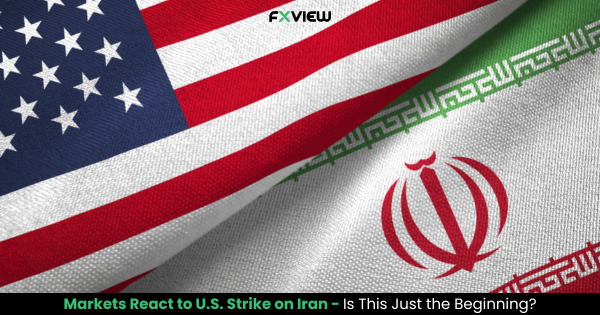
On June 22, the United States launched coordinated airstrikes on Iran’s nuclear facilities - Natanz, Fordow, and Isfahan - marking a sharp escalation in Middle East tensions. [Source]
With Iran signaling potential retaliation and the strategic Strait of Hormuz at risk, traders must prepare for further developments that could reshape market dynamics in the days and weeks ahead. This article explores the immediate impact of the strike, historical parallels, and the critical watchpoints that could define the next phase of this unfolding crisis.
Immediate Market Reactions
Markets have responded swiftly to the initial news of the U.S. strike on Iran, repricing risk across key asset classes. While the early reaction has been pronounced, it may represent only the beginning of a broader, more prolonged adjustment as geopolitical uncertainty persists.
- Equities:
Global equity futures fell sharply following the strike, with U.S. indices dropping as much as 1% before stabilizing. European and Asian markets reflected cautious selling amid uncertainty. - Commodities:
- Oil: Brent crude surged to a five-month high of $81.40 following the U.S. strike on Iran before pulling back sharply. Currently, prices have retraced significantly, with Brent now trading near $71.83.
- Gold: Despite its traditional safe-haven role, gold traded slightly lower in the aftermath of the strikes, as gains in the U.S. dollar outweighed geopolitical support.
- FX Markets:
The U.S. dollar strengthened, rising approximately 0.3% as investors rotate into safe-haven currencies. The Swiss franc and Japanese Yen attracted safe-haven flows. Emerging market and commodity-linked currencies weakened on risk aversion and energy sensitivity. - Bonds:
U.S. Treasury yields have edged lower as risk aversion supports demand for U.S. government debt. The 10-year yield has declined by approximately 5 basis points in early sessions.
Historical Context: How Markets Have Reacted in the Past
January 2020 – Soleimani Strike
- Following the U.S. drone strike on January 3, 2020, Brent crude surged over 2-4% initially before retreating within days as tensions eased.
- Brent closed around $68.60 before declining roughly 5.3% over the next week as tensions eased.
June 2019 – Gulf of Oman Tanker Attacks
- In June 2019, twin attacks on tankers near the Strait of Hormuz caused oil prices to spike around 4-5%.
- However, these price movements were short‑lived, with markets normalizing soon after, demonstrating a pattern where sharp spikes are often followed by quick retracements.
The pattern suggests that unless physical infrastructure or logistics are directly disrupted, geopolitical risk premiums tend to fade. However, the direct targeting of nuclear infrastructure introduces greater uncertainty and extends the tail-risk window, particularly given today’s inflation sensitivity and monetary policy divergence.
Market Outlook: Key Watchpoints for Traders
The U.S. strike on Iran may have triggered the first wave of market reaction, but it’s unlikely to be the last. With geopolitical tensions still unfolding and global markets on edge, traders should stay focused on several evolving factors that could reshape cross-asset behavior in the sessions ahead:
- Iran’s Response: Iranian officials have declared the U.S. attack widens their legitimate targets, including the possible launch of missiles, cyber-operations, or proxy escalation. Markets remain on alert for any such developments, as a direct or indirect response could extend the current volatility regime across commodities, FX, and global equities. Traders should monitor diplomatic signals and regional activity closely for early indications of escalation.
- Strait of Hormuz: Iran’s threat to close the Strait of Hormuz - a key route for 20-25% of global seaborne oil - introduces major supply risk. While no physical disruption has occurred yet, even limited interference could materially impact oil markets. A credible threat to shipping in the region could push Brent crude toward triple digits and exert upward pressure on inflation expectations, further complicating the global monetary policy outlook.
- Central Bank Communication: Persistent commodity-driven inflation may challenge dovish forward guidance from central banks. Fed and ECB communication will be crucial in shaping rate expectations.
- Emerging Markets & Sector Rotation: Vulnerability remains in EM currencies, especially oil-importing nations. Energy and defense-related assets may outperform amid persistent volatility.
Conclusion: Structured Response in Volatile Conditions
The U.S. strikes on Iranian nuclear infrastructure have marked a pivotal moment in global risk sentiment - but this is unlikely to be the final chapter. The situation remains highly fluid, and additional military, diplomatic, or economic responses from either side could rapidly alter the market landscape. From full-scale escalation to strategic de-escalation, the next phase of this conflict will likely redefine cross-asset behavior.
In this environment, the precision of execution is critical. Fxview offers institutional-grade spreads, deep liquidity, and execution reliability - delivering the precision and stability required to trade confidently in fast-moving geopolitical environments.
Disclaimer: This communication is for information and education purposes only and should not be taken as investment advice, a personal recommendation, or an offer of, or solicitation to buy or sell, any financial instruments. This material has been prepared without taking into account any particular recipient’s investment objectives or financial situation, and has not been prepared in accordance with the legal and regulatory requirements to promote independent research. Any references to past or future performance of a financial instrument, index or a packaged investment product are not, and should not be taken as, a reliable indicator of future results. Fxview makes no representation and assumes no liability as to the accuracy or completeness of the content of this publication.
Related Posts
View All Market AnalysisHarmonic Trading Patterns
What is Gartley Pattern?
In trading, tools and strategies count the most. One popular technique is the Gartley Pattern. Whether you are trading stocks, commodities, or diving into the depths of Gartley pattern in Forex trading, this pattern can be a game-changer for you. Continue reading to know more.
Read More4 Mins Read | Feb 12th 2025
















Related Posts
Feb 12th 2025
What is Gartley Pattern?
Feb 12th 2025
Fundamental Analysis
Feb 12th 2025
How to use the Crab Chart Pattern in Trading?
Feb 12th 2025
Start Forex Trading: 8 Essential Steps
Feb 12th 2025
9 Popular Economic Indicators in Forex
Feb 12th 2025
Market Sentiment Indicators- An Ultimate Guide!
Feb 12th 2025
What is Sentiment Analysis in Forex Trading?
Feb 12th 2025
9 Must-Know Harmonic Patterns in Forex
Mar 13th 2025
Is The Ukraine Conflict Affecting CFDs and Markets?
May 20th 2025
Will the RBA Cut Rates by 25 Bps on May 20?
May 20th 2025
Will the RBA Cut Rates by 25 Bps on May 20?
Jun 19th 2025
Oil Price Movements Amid Israel-Iran Tensions
Jun 19th 2025
Oil Price Movements Amid Israel-Iran Tensions


Ready to trade?
Open an account in less than 5 minutes. Start trading your way.